
Independent Study: Can Handheld LIBS Measure Organic Carbon in Soil?
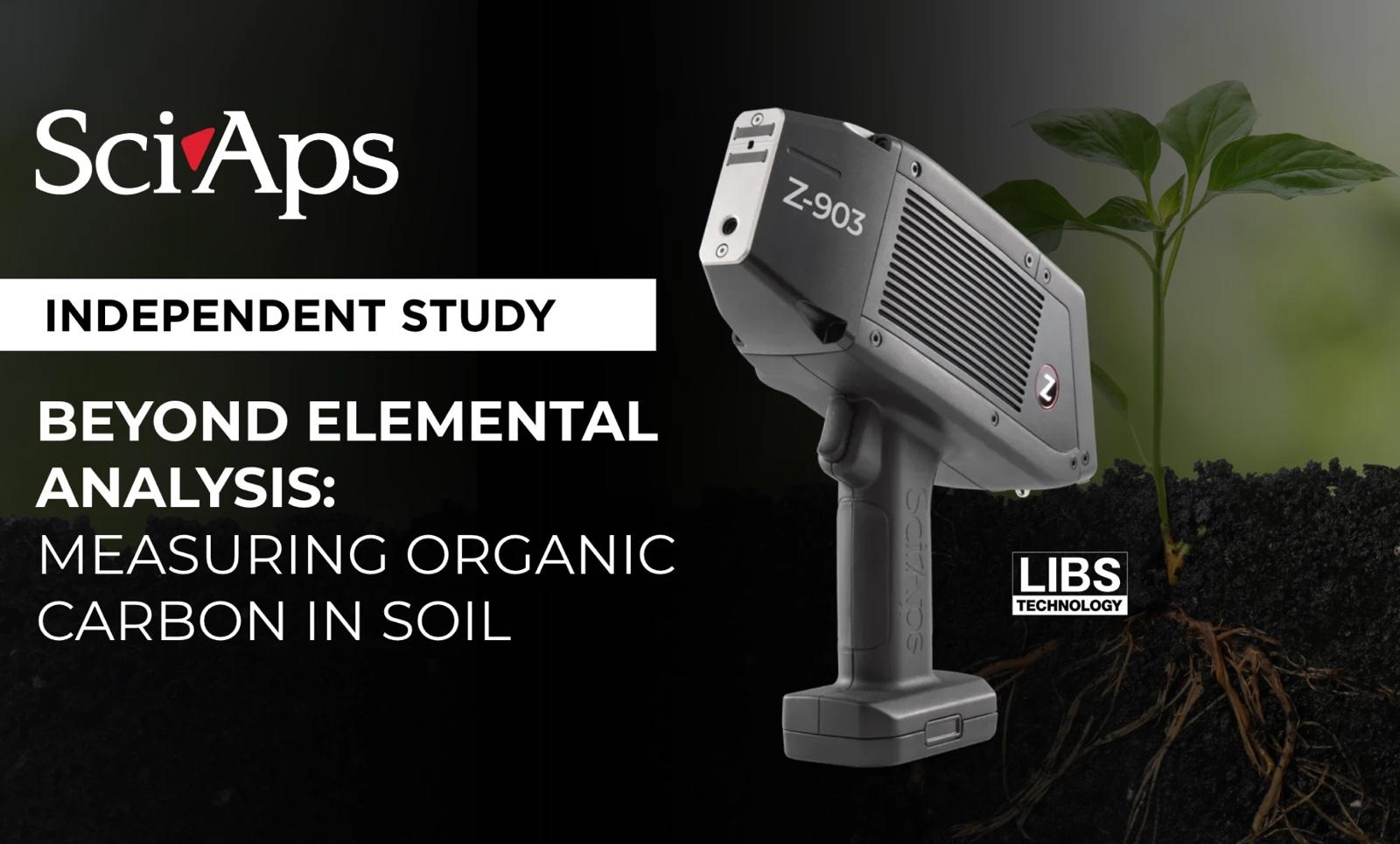
New research explores a direct, reagent-free approach to soil carbon analysis using the SciAps Z-903.
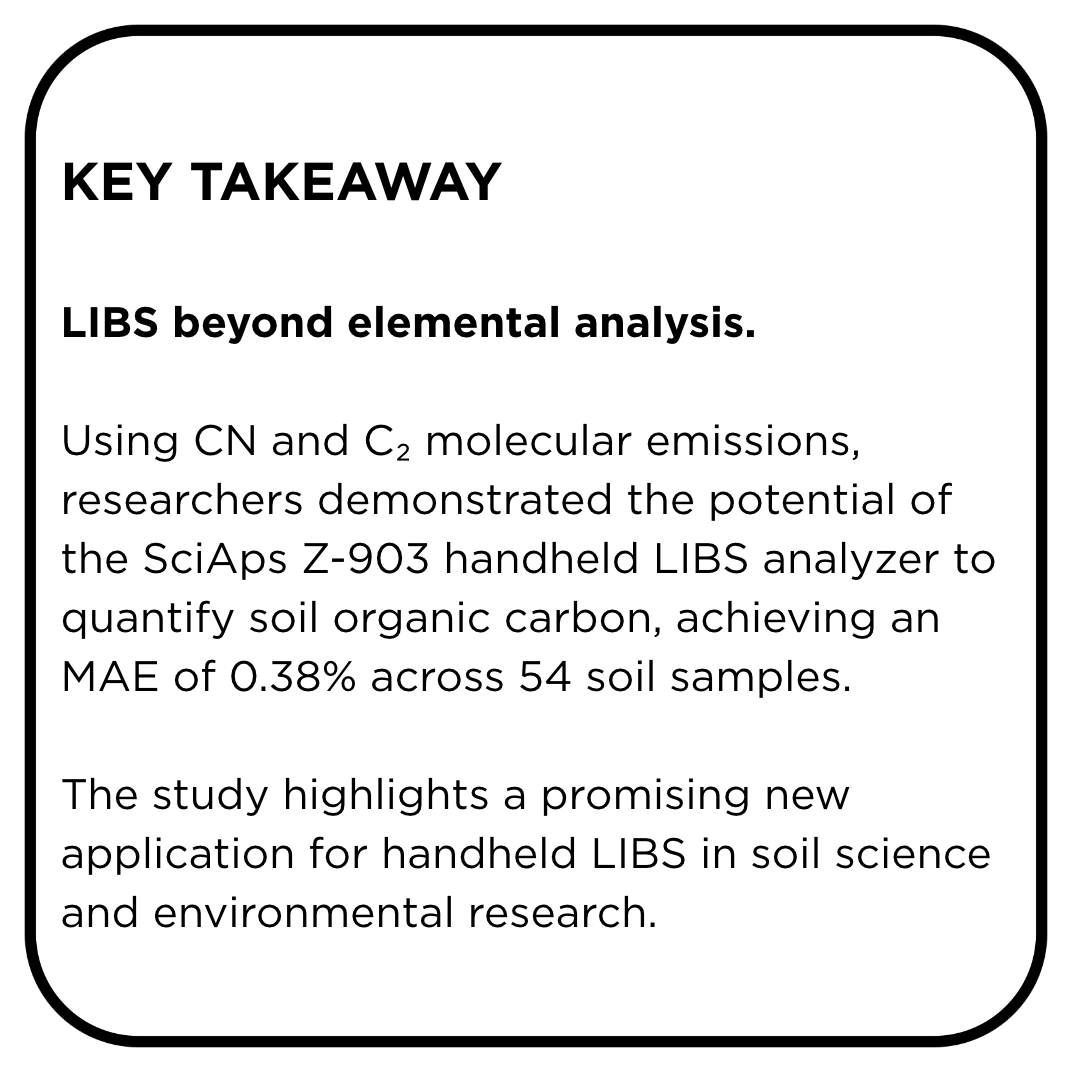
Soil plays an important role in the global carbon cycle, and understanding how much organic carbon it contains is essential to studying soil health, carbon sequestration, and climate change. But measuring total organic carbon (TOC) traditionally involves laboratory testing, chemical reagents, and time-consuming sample preparation.
Could handheld LIBS offer another approach?
A recent study published in the Journal of Analytical Atomic Spectrometry explores just that. Conducted by researchers at São Paulo State University (UNESP, Brazil), the University of Zaragoza (Spain), and Italy's National Research Council (CNR-ISTP), the study demonstrates the potential of the SciAps Z-903 for direct quantification of total organic carbon in soil.
The Challenge
Accurately measuring soil organic carbon is important for environmental research, agricultural management, and understanding carbon storage. Conventional methods, including dry combustion and wet chemical analysis, can be labor-intensive, expensive, and dependent on chemical pretreatment.
Researchers have been exploring LIBS as a faster alternative. However, many previous approaches have relied on indirect measurements and correlations between elemental signals and carbon content.
This study takes a different approach: measuring molecular emissions directly associated with organic matter.
The Research
Researchers evaluated two LIBS systems to investigate whether the molecular emissions of cyanogen (CN) and diatomic carbon (C₂) could be used as direct indicators of soil total organic carbon.
The study included 54 soil samples from different regions of Brazil, sourced from a soil proficiency-testing program run by the Agronomic Institute of Campinas and representing a range of soil textures and organic carbon concentrations. Reference TOC values were measured in the laboratory by dry combustion after removing inorganic carbon. For both instruments, the soils were sieved (2 mm) and pressed into pellets with a hydraulic press, and all measurements were made on these pellets under controlled laboratory conditions.
The researchers:
- Compared a laboratory-based Spark Discharge-assisted LIBS (SD-LIBS) system and a handheld LIBS (hLIBS) instrument.
- Used argon gas to create an inert analytical environment and minimize the formation of CN from atmospheric nitrogen.
- Measured CN and C₂ molecular emissions generated during laser ablation.
- Applied partial least squares (PLS) modeling to develop and validate predictive models for TOC quantification.
The authors describe the approach as “direct” because the CN and C₂ signals originate from the breakdown of organic molecules in the sample, rather than being inferred from other elements. As with most LIBS quantification, the TOC values themselves are predicted by multivariate models calibrated against laboratory reference measurements.
Where SciAps Fits In

The handheld instrument evaluated in this research was the SciAps Z-903.
The Z-903's broad spectral range (190–950 nm), argon-purge capability, and automated raster measurement features were well suited to the study's analytical approach.
The instrument's argon purge helped maintain the conditions needed to measure native CN and C₂ molecular emissions while minimizing the formation of interfering species. Its raster grid also allowed researchers to collect measurements across multiple areas of each soil sample.
By combining the Z-903's handheld LIBS capabilities with molecular spectral analysis and multivariate modeling, the researchers investigated an alternative approach to quantifying soil organic carbon. The TOC prediction models were developed by the research team for this study; they are not a standard, factory-installed Z-903 application.
The Results
The optimized Z-903 model demonstrated promising predictive performance when compared with reference laboratory measurements.
Key validation results included:
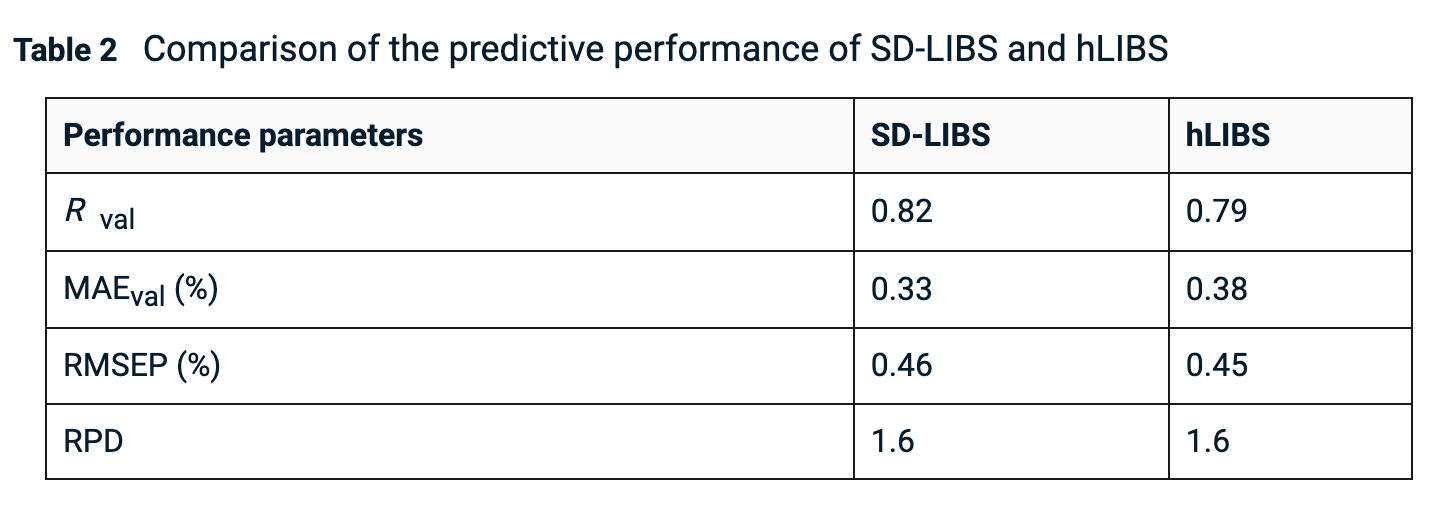
- R = 0.79: Correlation coefficient between predicted and reference TOC values.
- MAE = 0.38%: Mean absolute error, expressed in absolute TOC units. On average, predictions were within about 0.4 percentage points of the laboratory value (validation samples ranged from 1.3% to 3.3% TOC).
- RMSEP = 0.45%: Root mean square error of prediction.
- RPD = 1.6: Ratio of performance to deviation.
According to the authors, these results were comparable to those achieved using the laboratory-based SD-LIBS system (R = 0.82, MAE = 0.33%, RMSEP = 0.46%, RPD = 1.6, reported after excluding one validation sample with an unusually high prediction error). Together, they show that a handheld instrument could provide useful predictive information about soil organic carbon.
Model optimization was key to this result. An initial Z-903 model based only on 12 CN and C₂ wavelengths fit the calibration data well but predicted the validation samples poorly. Adding eight wavelengths selected for their strong correlation with TOC substantially improved the model's accuracy and predictive performance.
Why It Matters
This research expands the potential applications of handheld LIBS beyond traditional elemental analysis.
By using molecular emissions to assess organic carbon, the study introduces a different approach to soil characterization—one that could support faster, more accessible environmental and agricultural analysis.
Because the LIBS measurement itself requires no chemical pretreatment or reagents (only sieving and pressing the soil into pellets), the approach also offers potential environmental and operational benefits.
Further research is needed to evaluate the method across broader soil types and field conditions, and to better understand effects such as soil texture, moisture, and mineral content. Still, the findings represent an encouraging step toward more accessible soil carbon monitoring.
The Takeaway
The SciAps Z-903 continues to demonstrate the versatility of handheld LIBS technology.
From elemental analysis to the investigation of molecular emissions associated with organic matter, this research highlights new possibilities for applying LIBS to complex environmental challenges.
One more example of how handheld LIBS is expanding the boundaries of what's possible in analytical science.
Read the Original Paper
Publication: Balbino, R. R.; Gavrilov, Y. S.; Senesi, G. S.; Gomes Neto, J. A.; Ferreira, E. C. “Direct Quantification of Total Organic Carbon in Soils Using Native CN and C₂ Molecular Emissions by Laser-Induced Breakdown Spectroscopy (LIBS).” J. Anal. At. Spectrom. 2026, 41, 763–771, published 01 February 2026. https://doi.org/10.1039/d5ja00411j
Researchers: Rafael Rodrigues Balbino, Yusef Sadik Gavrilov, Giorgio Saverio Senesi, José Anchieta Gomes Neto, Edilene Cristina Ferreira
Abstract: “The soil carbon cycle plays a central role in global warming, making accurate mapping of Total Organic Carbon (TOC) in soils essential for climate change mitigation. Conventional TOC determination methods are often time-consuming, costly, error-prone, and environmentally unsustainable due to the use of chemical reagents and extensive sample preparation. This study introduces a proof of concept for a chemically grounded LIBS-based approach that enables the direct quantification of TOC in soils by exploiting the emission of native CN and C₂ molecular species. Two Laser-Induced Breakdown Spectroscopy (LIBS) systems, Spark Discharge-assisted LIBS (SD-LIBS) and a handheld LIBS device (hLIBS), were evaluated using soil samples with different textures and TOC levels. Argon purging ensured inert plasma conditions favoring CN and C₂ native species in the plasma, while Ar emission lines were used to perform spectral normalization. For SD-LIBS, a Partial Least Squares (PLS) model based on 12 CN and C₂ wavelengths achieved an R = 0.90 in calibration and an R = 0.82 (MAE = 0.33%) in validation. The hLIBS model, combining 12 CN and C₂ emission bands and 8 more correlation-selected wavelengths, yielded R = 0.96 for calibration and R = 0.79 (MAE = 0.38%) for validation. Both systems delivered comparable analytical performance, demonstrating the feasibility of rapid, reagent-free, and in situ TOC quantification in soils. The proposed approach paves the way toward sustainable soil monitoring and carbon management strategies.”
Keywords: Soil, TOC, CN and C₂ molecular emissions, direct analysis, LIBS.
Access to publication: Journal of Analytical Atomic Spectrometry
About this journal: Journal of Analytical Atomic Spectrometry: Setting the standards in atomic spectrometry.